



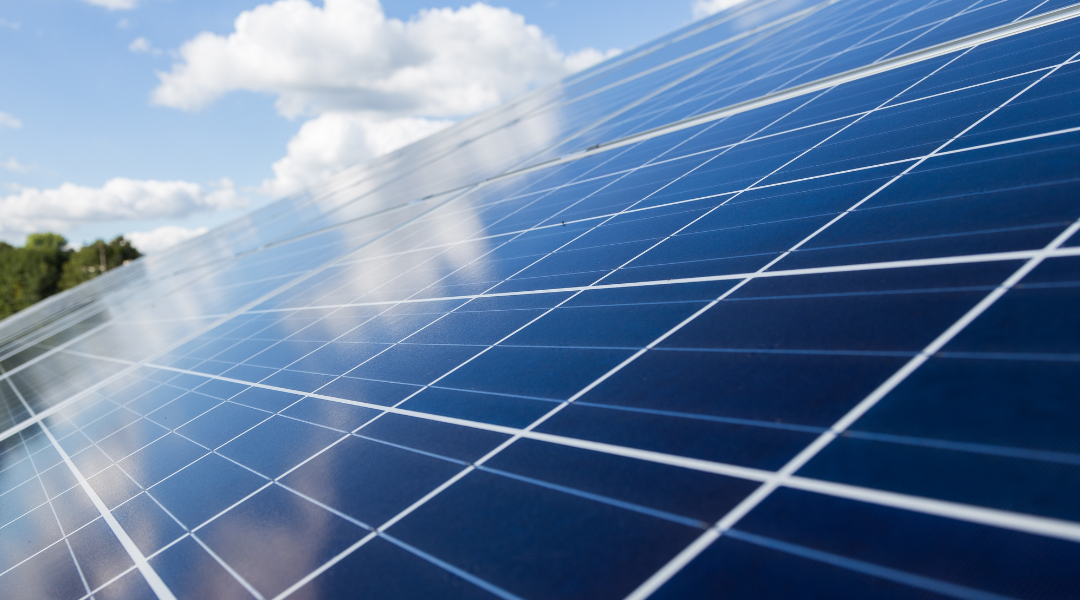
There are no plans for a big increase in the number of solar panels on government buildings.
That’s the message from Infrastructure Minister Jason Moorhouse.
However, the possibility of a “direct to grid solar array” at the National Sports Centre is being investigated.
Moorhouse said: “There are currently no plans for a significant increase in solar PV installations across the Government
estate in the short term.
“While PV will continue to be considered where it is technically and financially appropriate, the operating profile of many government buildings means that the electricity generated does not always align sufficiently with periods of demand to provide an attractive financial return.”
He added: “The department is, however, currently working with Manx Utilities to explore the potential for a direct-to-grid solar array at the NSC.”
The NSC complex in Douglas, is next to Pulrose Power Station.
Only 1.3% of Govt Buildings Have Solar Panels
Moorhouse was responding to a written Tynwald question posed by Glenfaba and Peel MHK Katryna Baptist. She wanted details on how many government-owned buildings had solar panels on them.
She also asked about any government plans to increase the number of panels, “including timescale and budget; what return on investment is being generated by existing installations; and what the forecast payback period is”.
Moorhouse revealed: “Approximately 1.3% of government-owned buildings currently have solar photovoltaic (PV) panels installed, based on 11 buildings from an estate of approximately 825.”
He added: “The department’s approach is therefore to consider solar PV as one element of its wider programme
to decarbonise government buildings, rather than as a standalone programme.”
Decarbonisation
A “decarbonisation road map” had been developed, covering 336 buildings and “identifying potential retrofit requirements and investment priorities through to 2050”.
The minister said: “The road map considers an investment pathway of approximately £5 million per annum across the wider decarbonisation of the estate and is not a dedicated solar PV budget.”
Investment would be prioritised across a range of measures, including insulation, LED lighting, building controls, low-carbon heating and, where appropriate, solar PV.
“Decisions will take account of the condition and future use of buildings, energy consumption, technical suitability, and the financial and carbon savings achievable.”
There was no single payback period on solar panels, he added.
“Returns are dependent on factors including roof suitability, installation cost, generation potential, electricity tariffs and, importantly, the extent to which electricity generated can be consumed on site at the time it is produced.”
Solar PV would remain an option at individual buildings where there was a “robust business case”.
“However, the department’s immediate focus is on those decarbonisation measures that provide the strongest financial and carbon benefit across the estate,” he said.