

Business Isle of Man celebrates “delivery” in its 2026 programme. Yet the bombshell figures released this week, tell a rather different story.
By any measure, 2026 should have been a year of vindication for the Department for Enterprise’s agency model.
Almost a decade has passed since the creation of the ‘executive agency’ structure. Taxpayers have funded it. Politicians have defended it. Boards have overseen it. Chief executives have managed it. Strategy documents have been produced. Consultations have been held. Programmes have been launched. I’m sure by now you get the idea: This is a hotbed of civil service and public sector officialdom.
Surely, after nine years, there should now be a substantial body of evidence demonstrating that the model has worked?
Instead, one of the most striking observations in Business Isle of Man’s latest programme is how little of it focuses on outcomes.
Page after page details strategies, engagement, action plans, partnerships, initiatives, support programmes and consultations. There is much discussion of what the agency does. There is far less discussion of what measurable economic improvements have actually been achieved as a direct result.
That criticism is not merely coming from outside commentators.
That observation now casts a long shadow over Business Isle of Man’s latest claims of success.
The Big Manx Feast Problem
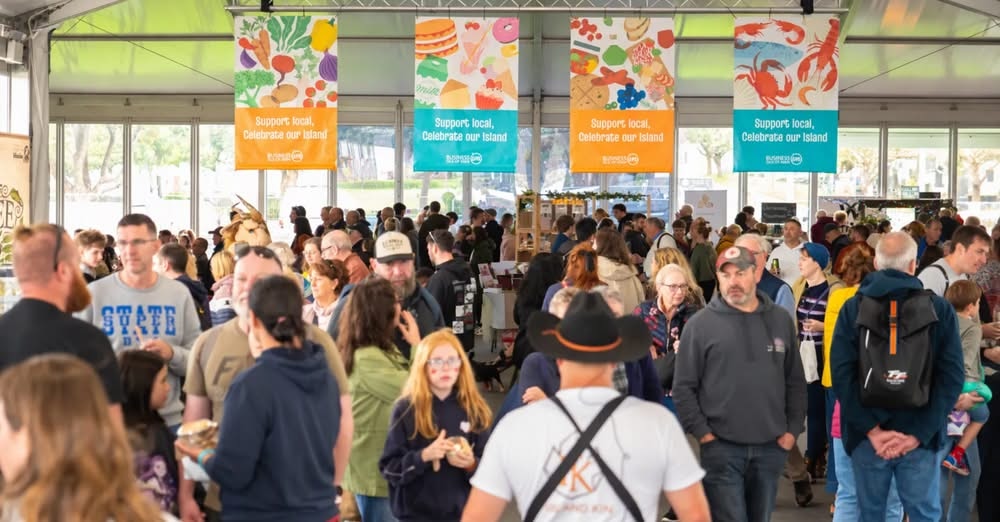
Nothing illustrates the issue better than the Big Manx Feast.
Strangely the government department with the brief for ‘food’, no longer organisers the food and drink festival, nor does it seem to promote food. That being DEFA…. the Department of Environment Food and Agriculture.
Instead, they clearly needed something for Business Isle of Man to do, so they assumed responsibility for delivering the event and described it as a cornerstone initiative supporting the food and drink sector. And yes, the standard DFE answer to everything is… let’s have a new website.
Now, two months after the event, the numbers are now well known. And they do not look good.
Attendance Poor
The event attracted 6,389 attendees, rising to 6,739 when participants were included. Previous food festivals reportedly attracted between 7,000 and 16,000 attendees.
Income totalled £85,795.
Expenditure reached £170,839.
The resulting deficit was £85,045.
Those figures alone present an obvious challenge to any attempt to present the event as a success. Even the best government spin doctor cannot possibly hail this as a success.
However, officials have pushed back by pointing to a post-event assessment which estimated the festival generated approximately £454,000 in wider economic activity and produced a net economic benefit of £21,407. A full economic impact report is expected later.
And it is here that some important questions arise.
Where Did £454,000 Come From?
The figure has been repeated frequently. £454,000. It sounds impressive.
Indeed, it sounds sufficiently impressive to transform the narrative from one of overspending and declining attendance into one of economic success.
But where exactly has this figure come from?
The information released publicly so far provides the headline number but not the detailed methodology used to reach it. Was it based on actual spending surveys? Was it derived from assumptions about average visitor expenditure? Did it include estimated future purchases? Were local residents’ purchases counted despite that money already circulating within the Manx economy? How were displacement effects calculated? How many assumptions were required to convert fewer than 7,000 attendees into almost half a million pounds of economic activity?
At present, taxpayers have been invited to accept the figure without being shown the workings behind it.
That does not necessarily mean the estimate is wrong but does mean it has not yet been fully scrutinised. And when a publicly-funded agency is relying on such a figure to justify an event that spent over £170,000, scrutiny becomes entirely reasonable. Indeed, it becomes essential.
Activity Is Not Achievement
This issue extends far beyond a single food festival.
The broader criticism levelled by the Economic Policy Review Committee was that the Department and its agencies have become heavily focused on measuring activity.
Meetings held – Businesses engaged – Events attended – Campaign impressions – Programmes delivered – Strategies developed – Consultations undertaken.
All of these things may have value but of them, by themselves, demonstrate success.
The distinction matters because taxpayers are not funding Business Isle of Man to produce activity. They are funding it to improve economic performance.
The question therefore becomes remarkably simple: Where are the results?
Nine Years On
Perhaps the most damaging finding within the Economic Policy Review Committee’s report concerns what happened to the original promise of the agency model itself.
When the model was introduced, agencies were expected to become increasingly industry funded and reduce burdens on the public purse.
According to the Committee, that aspiration appears to have quietly disappeared. The report notes a 91.8% increase in net expenditure since 2018-19 and concluded that the Department had effectively abandoned the aim of becoming predominantly industry funded.
Meanwhile staffing levels across the Department remain substantial.
Staffing Up – What are they all doing?
The Committee noted that there were 193.5 full-time equivalent filled posts (includes other DFE divisions) compared to 171.89 when the model was first introduced, adding that current staffing levels appeared difficult to justify against the outputs being delivered.
That observation is uncomfortable reading when viewed alongside the Business Isle of Man team structure and the continuing demands being placed on taxpayers.
What exactly is the organisation delivering that could not be delivered more efficiently through a conventional government department?
Nine years after the creation of the agency model, that remains a surprisingly difficult question to answer.
The Question Government Must Answer
During the Tynwald debate on the committee’s findings, the central issue repeatedly resurfaced. Not whether staff are working hard, whether agencies are busy and not whether reports are being written. But whether the public is receiving value for money.
That is ultimately the test that matters.
No taxpayer expects economic development to be easy. No one expects every initiative to succeed. But they are entitled to expect evidence. Evidence that spending more money is producing better outcomes. Evidence that larger organisational structures deliver greater value. Evidence that agencies are achieving something that could not otherwise be achieved.
And evidence that headline claims, such as the Big Manx Feast’s reported £454,000 economic impact, are based on robust and transparent analysis rather than assumptions that conveniently support an existing narrative.
Until that evidence is produced, the conclusions reached by Jason Moorhouse’s committee during the last parliamentary sitting will continue to hang over Business Isle of Man and the wider Department for Enterprise.
Because after nearly a decade, the debate is no longer about activity – It is about outcomes. And for many taxpayers looking at the numbers, that debate is only just beginning.
Rookie Minister Inherits a Behemoth

A final and perhaps unavoidable question now lands on the desk of new Minister Rob Cowell MHK. Can Cowell rein in the Behemoth?
Having campaigned on promises of reform, efficiency, accountability and a government that delivers tangible results, he now inherits an agency structure that was heavily criticised in the last parliamentary session.
Cowell Has The Blue Print For Change
Tynwald’s Economic Policy Review Committee, concluded the model had failed to achieve its original objectives and was too often measuring activity rather than outcomes. This should help Cowell, as it gives him the blue print for change. It also gives him the ‘backing’ for actually getting on with it without the usual waffle of ‘having another review’.
The new Minister will ultimately have to decide whether Business Isle of Man and the wider agency model continue as they are, undergo meaningful reform, or face more fundamental restructuring such as being abolished completely.
For a public increasingly sceptical of strategies, consultations and headline-grabbing claims unsupported by transparent evidence, the expectation is clear. The next few months will not be judged on how many meetings are held, reports commissioned or initiatives announced. They will be judged on whether Rob Cowell delivers the accountability, value for money and measurable economic outcomes he promised voters.
The spotlight is now firmly on him.