

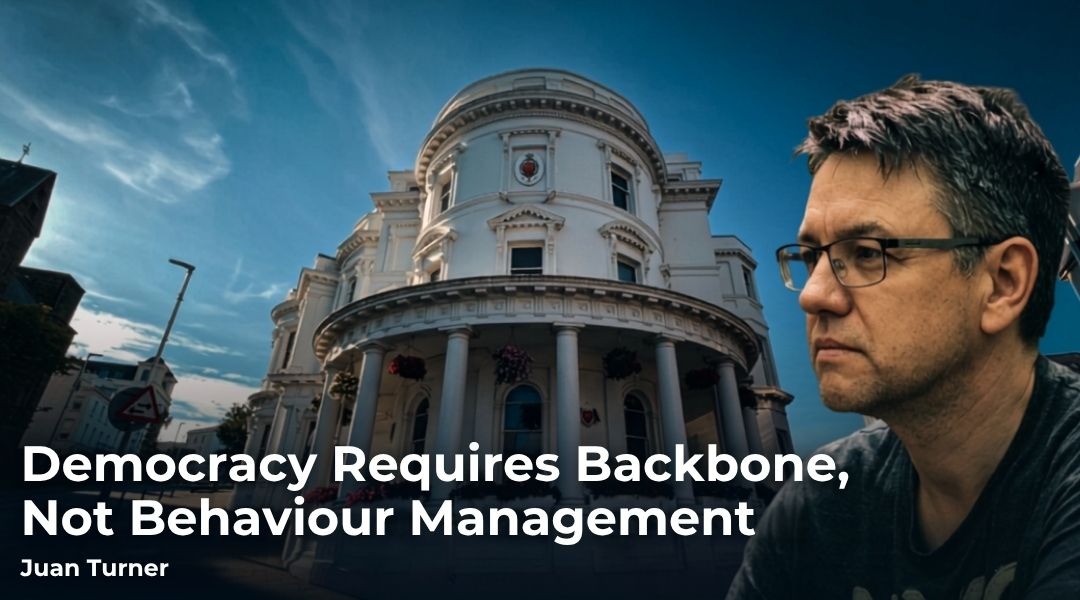
As a former Member of the Legislative Council, I spent years inside Tynwald and now observe it from the outside. In that time, I have seen the Island’s political culture evolve, sometimes for the better, sometimes in ways that should give us pause. One of the most concerning developments today is the growing belief that parliamentary debate should be governed by the same expectations of “kindness” and interpersonal harmony that apply in ordinary workplaces.
It is an attractive idea. It sounds modern, civilised, and humane. But it is constitutionally misguided.
It is a democratic arena where disagreement is not only expected but required. It is a place where elected representatives must be free to speak plainly, challenge fiercely, and confront uncomfortable truths. And it is a place where voters — not political opponents, not committees, not colleagues — must judge the words and conduct of those they elect.
The Drift Toward Sanitised Politics; or ‘Gagging’?
Over this political term I have watched a subtle but significant shift in Tynwald’s culture. Strong political language, heated exchanges, and sharp criticism are increasingly being treated as matters for disciplinary intervention. The Code of Conduct is being applied as though Members were employees in a corporate office, with “kindness” and “tone” becoming criteria for formal scrutiny.
This is a dangerous drift.
The expectation that politicians must always be kind misunderstands the nature of democratic politics. Kindness is a personal virtue. It is not a constitutional requirement. The Oath sworn by Members does not demand kindness; it demands truthfulness, independence, courage, and the willingness to deliver one’s opinion “without favour or affection, love or fear.” These are the qualities that protect democracy. These are the qualities that allow representatives to challenge power, defend constituents, and expose wrongdoing. It is adversarial by design.
When Parliament Starts Regulating Public Speech
Tynwald has also extended its disciplinary reach far beyond the chamber itself. Under the current Code of Conduct, Members can now be investigated for what they post on social media or write / say in the press, with clauses such as “Members must never undertake any action which would cause significant damage to the reputation and integrity of Tynwald” and “Members must not use social media… to bully, harass or otherwise treat another person in a way that would breach workplace standards” being applied to public political commentary. This means that ordinary political criticism, the kind voters expect to see from their representatives, can now trigger formal scrutiny simply because it is forceful, confrontational, or unwelcome.
Once a parliament begins regulating what Members say outside the chamber, it is no longer protecting its integrity; it is policing democratic speech. And that is a line no legislature should cross.
If political speech is regulated according to whether it is “kind,” then political speech will inevitably become timid. Members will avoid saying what needs to be said. They will soften criticism, dilute scrutiny, and retreat from confrontation; not because issues are resolved, but because the rules punish the expression of political frustration or urgency.
Those who argue that “people should be nicer” often do so with good intentions. They want civility, respect, and a calmer political climate. But civility cannot be imposed through disciplinary codes. Respect cannot be mandated by committees. And calm cannot be manufactured by policing adjectives. When institutions attempt to enforce kindness, they do not create harmony; they create silence.
The proper check on political speech is not an internal disciplinary process. It is the electorate.
This is the foundation of democratic accountability. It is not for political opponents to decide which words are permissible. It is not for committees to determine whether criticism is too sharp. It is not for colleagues to police each other’s tone. The moment parliamentary speech becomes subject to HR‑style behavioural management, the democratic relationship between representatives and the public is weakened.
When Parliamentary Speech Is Policed, Democracy Weakens
When elected representatives begin to fear disciplinary action for sounding like politicians, they will stop behaving like politicians. They will sanitise their speech, soften their criticism, and avoid confrontation: Not because the issues are resolved, but because the rules now punish the expression of political anger, frustration, or dissent.
Tynwald must decide whether it wishes to remain a chamber of democratic challenge or become a workplace governed by interpersonal comfort. The direction of travel suggests the latter and that is constitutionally dangerous.
Kindness is a virtue. But courage is a duty. And democracy depends on the latter far more than the former.
More to come on this no doubt.