


Nearly 20 Years of Warnings: Why Has the Isle of Man Still Not Created an Independent Police Conduct Body?
With a general election due in September and the current administration entering its final months, the Department of Home Affairs faces a growing and unavoidable question: why does the Isle of Man still not have an independent body to investigate police conduct, despite almost two decades of formal recommendations urging its creation?
The Island remains one of the few jurisdictions in the British Isles without external oversight of police complaints. The absence of such a safeguard has been highlighted repeatedly, most notably in the 2006 Redmayne Select Committee Report, which identified serious weaknesses in the Island’s police complaints system and recommended a more independent model. Yet successive administrations — including the current one — have allowed the issue to drift, leaving the Island reliant on internal or inter‑force arrangements that critics say lack credibility and fall far short of modern standards.
2006: A Warning That Has Gathered Dust
The 2006 Select Committee examined the police complaints system in detail, taking evidence from the Constabulary, the Police Complaints Commissioner, the DHA, and the Independent Police Complaints Commission (IPCC) in England and Wales.
Its findings were stark: complaints were not always handled promptly, not always handled effectively, and crucially, not handled with sufficient independence to maintain public confidence.
The Committee recommended a more robust, independent structure.
That recommendation has now sat unimplemented for nearly 20 years.
A Recruitment Advert That Revealed a Deeper Cultural Problem
The issue returned to public attention when a Manx police recruitment advert circulated during the TT period promoted the absence of an IOPC as a “benefit” of working for the Constabulary. The advert stated that the Isle of Man has “no Independent Police Complaints Commission,” a line that drew condemnation in Tynwald.
MHK Tim Glover described the messaging as “disturbing,” warning that using the lack of independent scrutiny as a recruitment incentive “undermines what we have here.”
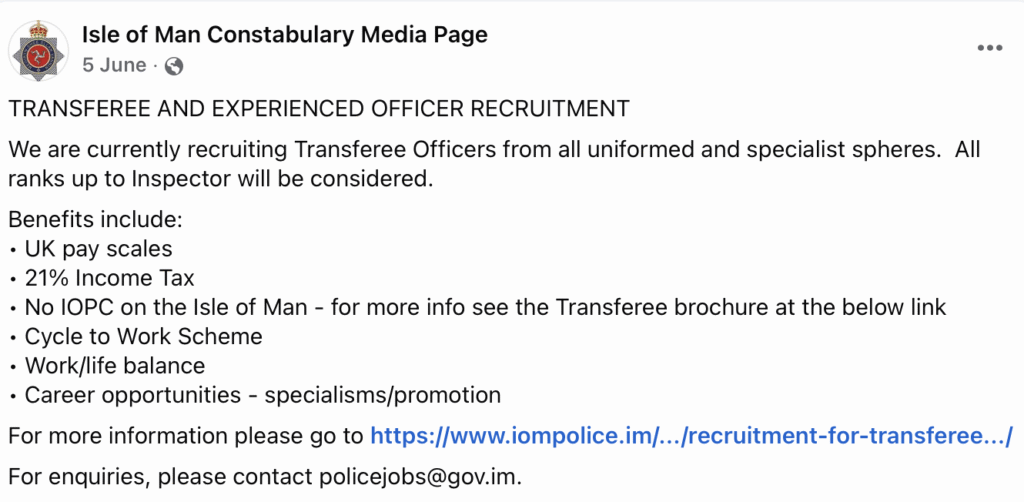
For many, the advert crystallised the very problem the 2006 report warned about: a system where the absence of external oversight is not just tolerated — it is normalised.
The Karran Inquiry: A Mirror Held Up to the Department
Although unrelated to police complaints, the Karran Inquiry into the Island’s parole system (2003) exposed strikingly similar structural weaknesses within the Department of Home Affairs. The independent investigation found outdated legislation, weak governance, inadequate oversight, poor inter‑agency coordination, and a failure to act on clear recommendations.
The parallels are difficult to ignore.
Both the Redmayne Report and the Karran Inquiry reveal a consistent pattern: critical public‑safety systems overseen by the DHA have been allowed to stagnate, with recommendations left unimplemented for years. The Karran Inquiry demonstrated that the problem is not confined to policing — it is systemic.
A Minister Prioritising “Deliverable Objectives” — While Ignoring One Deliverable Since 2006
The current Minister for Home Affairs, Jane Poole-Wilson MHK has defended her legislative programme by saying the Department must focus on “the most critical and deliverable objectives” before the end of the parliamentary term. In her 2025–26 Department Plan, she highlighted a long list of Bills she intends to progress: Justice Reform amendments, a new Extradition Bill, fire safety legislation, national infrastructure security, updated surveillance laws, and a suite of secondary regulations covering liquor licensing, jury eligibility, police regulations, modern slavery, and sexual offences.
The Department says these items are “on track,” with consultations and drafting work either complete or scheduled. Other reforms — firearms, hate crime, sentencing, information‑sharing, and surveillance law replacement — have been postponed until the next administration.
But conspicuously absent from the Minister’s priorities is the creation of an independent police conduct body — a reform recommended in 2006, reaffirmed repeatedly since, and widely regarded as a basic safeguard across the British Isles.
The Minister’s own explanation for her legislative choices now raises a sharper question:
If the Department is prioritising deliverable objectives, why has it ignored one that has been deliverable for nearly two decades?
The Department has clearly had the capacity to legislate. It has drafted and progressed complex Bills expanding police surveillance powers, updating extradition processes, reforming fire services, and preparing for MONEYVAL. Yet it has not produced a single clause establishing independent scrutiny of police conduct.
Critics argue that this is not an oversight but a conscious political choice. After a full five‑year term, with clear recommendations on the table and mounting public concern, the continued absence of an independent police conduct body suggests that — for reasons the Department has never explained — this long‑needed safeguard simply has not been a priority.
Why Not Use the UK’s IOPC? Other Small Jurisdictions Do. What Is the Isle of Man Afraid Of?
One question now being asked more openly is why the Isle of Man has not simply chosen to contract with the UK’s Independent Office for Police Conduct (IOPC) — a model that would provide immediate, credible, and internationally recognised independence.
Comparable jurisdictions already do this:
- Gibraltar refers serious cases to external UK bodies.
- Jersey uses independent UK investigators for sensitive complaints.
- Guernsey has arrangements allowing external oversight when required.
- The Falkland Islands and other Overseas Territories routinely rely on UK institutions for specialist, independent scrutiny.
These jurisdictions recognise that small islands face inherent challenges in maintaining independence when everyone knows everyone. External oversight solves that.
The Isle of Man already relies on UK institutions for forensic science, aviation safety, and other regulation. There is no structural barrier preventing the Island from entering into a service agreement with the IOPC or adopting a hybrid model where serious or sensitive cases are referred externally.
Yet the Department of Home Affairs has never publicly explored this option.
It has not commissioned a feasibility study, opened a consultation, or even acknowledged the possibility in its legislative planning.
This silence raises a difficult question:
If the UK’s IOPC offers real independence, why has the Isle of Man avoided it?
Critics argue that the reluctance to use an external body suggests a deeper discomfort with genuine scrutiny. An IOPC‑style arrangement would remove control from the Department, limit the influence of local networks, and expose the Constabulary to the same level of external accountability expected elsewhere in the British Isles.
For a government that insists it is committed to transparency, the refusal to consider the most transparent option available is becoming increasingly hard to justify.
Years of Delay, No Delivery
Despite acknowledging the need for reform in principle, the DHA has produced no draft legislation, launched no public consultation, set no timetable, and repeatedly deferred action with references to “ongoing consideration.” Meanwhile, the UK has moved from the IPCC to the stronger Independent Office for Police Conduct (IOPC), while the Isle of Man remains anchored to a framework rooted in the early 1990s.
The Clock Is Running Down
With the election looming, the window for meaningful action is closing. If the DHA does not act now, the responsibility will fall to the next administration — extending a delay that has already lasted nearly two decades.
The central question is now unavoidable:
Why has the Department of Home Affairs failed to implement a reform recommended in 2006, reaffirmed repeatedly since, and considered standard across the UK — and why is the Isle of Man still operating a police complaints system that was deemed insufficiently independent twenty years ago?
As public pressure intensifies, the Government may soon be forced to explain why the Island remains out of step with modern oversight standards — and why the public is still waiting for a safeguard that most jurisdictions introduced long ago.