


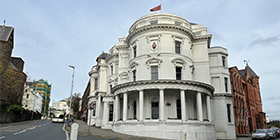


The Department for Enterprise and its Executive Agencies have “failed to meet any” of the objectives set when the model was created in 2017.
This is according to a highly critical report from Tynwald’s Economic Policy Review Committee made up of Jason Moorhouse MHK, Kate Lord-Brennan MHK and John Wannenburgh MHK.
The Committee’s second report of the 2025–26 session concludes that the current structure is fragmented, duplicative and inefficient, with responsibilities for business development, inward investment and marketing dispersed across multiple bodies in a way that “creates duplication, confusion, and inefficiency”.
Bureaucratic
Business groups told the Committee that the Department has become overly process‑driven, slow to act, and unclear in how it engages with industry. The Chamber of Commerce said its members see “a lack of clarity in how Government engages with business” and described the model as “overly risk averse and bureaucratic”.
The Committee found that the Department is not providing the strategic leadership originally envisaged.
Instead, Agency Boards are setting their own priorities and performance measures, resulting in sector‑by‑sector activity rather than a unified economic strategy.
This, the report says, is “in conflict with the original intention that the Department set strategy and policy”.
Value For Money
Concerns were also raised about the Department’s ability to demonstrate value for money.
The Committee said there is “insufficient transparency regarding the return on public investment”, with reporting focused on activity rather than economic outcomes such as productivity, sector growth or long‑term value creation.
Metrics such as meetings held, events attended or campaign impressions “do not evidence that these interactions translated into tangible economic benefits”.
The report highlights a sharp rise in public spending on the Agencies. Net expenditure has increased by 91.8% since 2018–19, despite early commitments that the Agencies would become predominantly industry‑funded.
The Committee notes that this goal “does not appear within the most recent Department Plan” and concludes that the Department “has simply given up on this aim”.
Staffing levels have also remained high. The Department currently has 193.5 full‑time equivalent filled posts, compared with 171.89 in 2017.
The Committee says the reduction promised at the time of the Agencies’ creation “has been marginal” and that current staffing levels “seem to us to be unjustified in relation to the Department’s outputs”.
Independent Review Needed
The Committee was critical of the Department’s plan to conduct an internal review of the Agency model, warning that such an approach “lacks independence” and risks the Department “marking its own homework”.
It recommends that the scope and purpose of the Department be reviewed by an independent third party alongside future reassessment of the Island’s Economic Strategy.
The report also calls for a unified place‑marketing strategy, a clearer framework for business development, and consideration of whether the Business, Finance and Digital Agencies should continue in their current form. It recommends that Visit Isle of Man be re‑established as a statutory Tourism Board.
Overall, the Committee concludes that the Department’s current structure is not delivering the strategic, coordinated economic leadership required, and that significant reform is needed if the island is to meet its long‑term economic ambitions.
The full report can be found here.
