



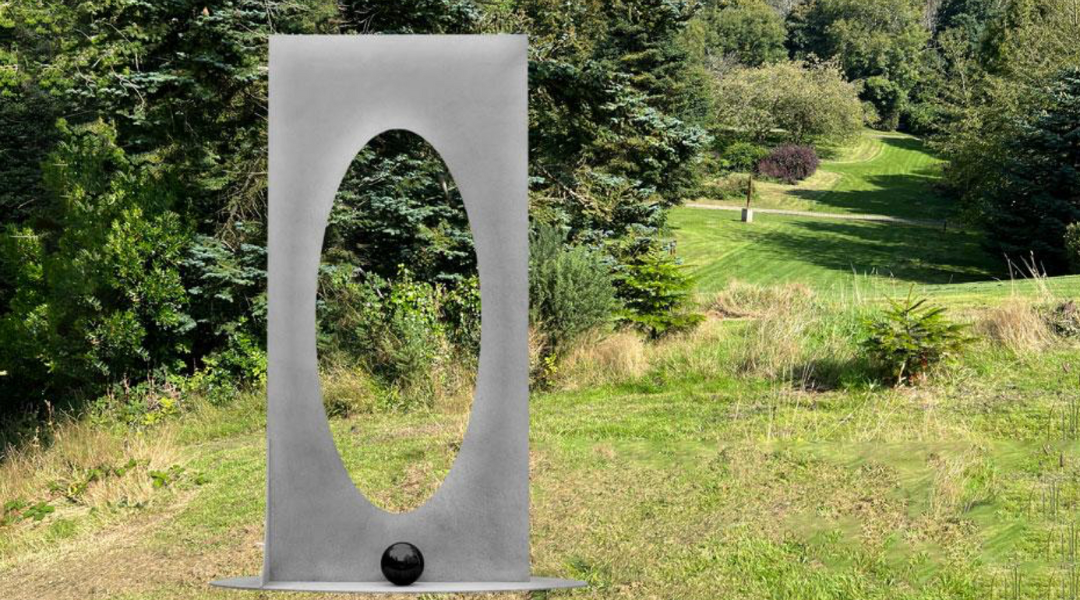
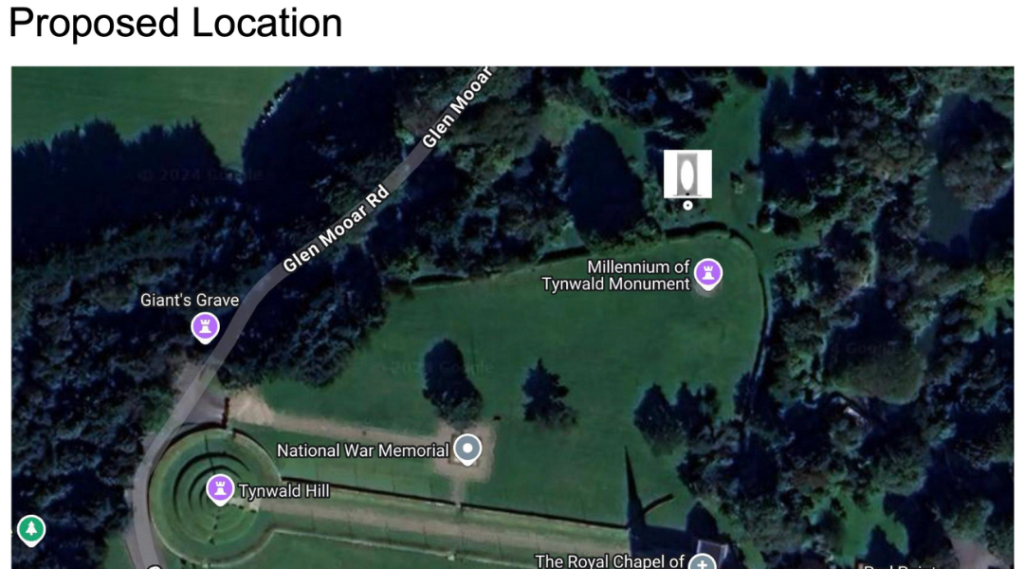
Plans have been submitted for artist Bryan Kneale’s Eelips sculpture to be placed near Tynwald Hill.
The proposed site would be in Tynwald National Park and Arboretum in St Johns.
Plans were initially revealed back in January for the sculpture to be placed at Niarbyl, but this was met by public backlash with concerns raised about it spoiling the natural landscape.
The submitted planning application would see the sculpture placed at the top of the hill near the wall at the fairground.
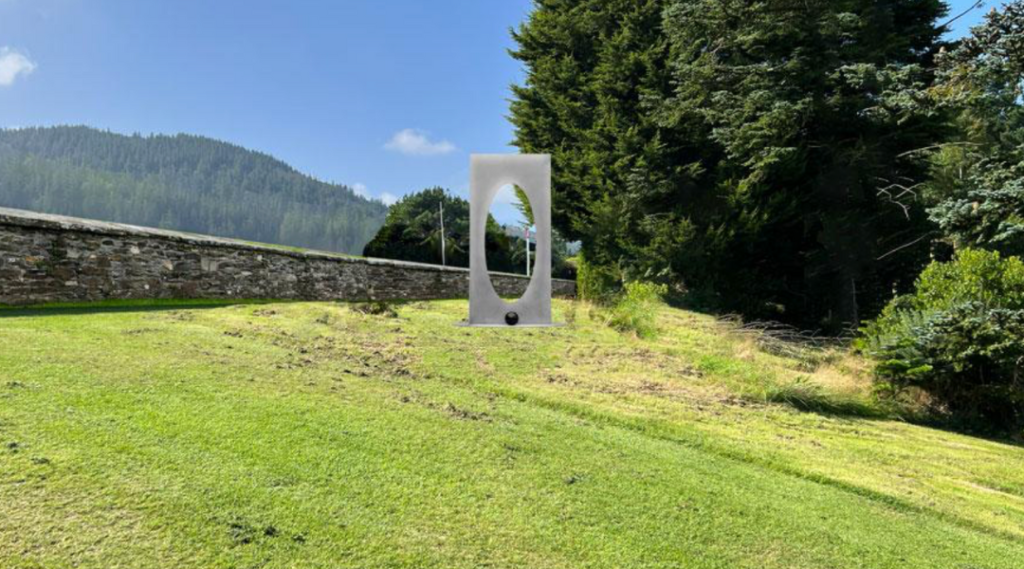
Eelips
The application says: “While the world was in lockdown due to the COVID-19 pandemic, Bryan began a new series of works featuring a void, including Coral and Dhoon.
“The void in these elegant works is a departure, both in practice and in life; at the age of 94, Bryan considers the finality of his journey in this work, moving through the void to a place unknown.
“It also however has the effect of focusing the viewer on the internal space, the centre where the sculpture would normally lie, and as such he allows their imagination to complete the work.
“In the case of Eelips (Ellipse) this focus will be the island, the surrounding land and sky incorporated into the work, and placing the visitor within it, forming their own unique viewpoint, with the artist and landscape continuing to excite a new generation.
“For Bryan, it attempts to remove the unknown of a void, celebrating the Manx landscape as a place of comfort and lifelong inspiration to which he will always be inextricably linked.”
Funding
Isle of Man Arts Council have confirmed Eelips (Ellipse) will enter into their national collection, and be under their ownership, making them responsible for insurance and maintenance.
The total cost of £96,984 has been met in part £60,000 of funding from the Isle of Man Arts Council, plus £2,984 from Culture Vannin.
A further £5,000 has been donated by the Kneale family, with £29,000 coming from the Royal Academy Frampton Fund.
Kneale
Bryan Kneale is a renowned Manx artist, born in Douglas in 1930. He originally studied painting at Douglas School of Art in 1947, before being accepted to the illustrious RA Schools programme where by 1960 he developed his widely exhibited sculptural practice.
Despite spending much of his life in England his spirit has always been tied to the Isle of Man. The stories and landscape of the Island have always permeated his work.
He said: “I am fairly obsessed with the place I came from, the Isle of Man, which is mountainous and by the sea – it would be wonderful to make something which would work in that landscape.”
His most famous on-island installation is the three legs at Ronaldsway.
7 Comments