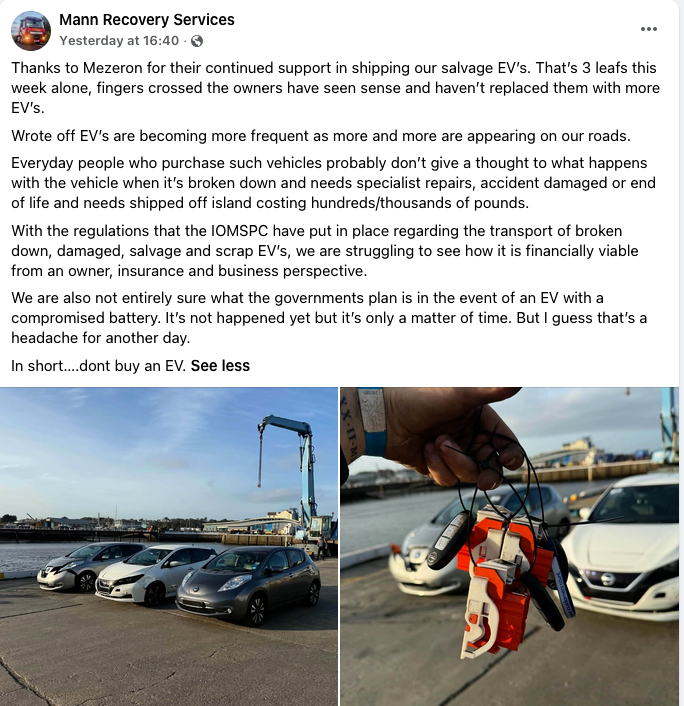

A leading Isle of Man vehicle recovery operator has sounded the alarm over what it believes is a growing and largely overlooked problem facing the island as electric vehicle (EV) ownership continues to rise.
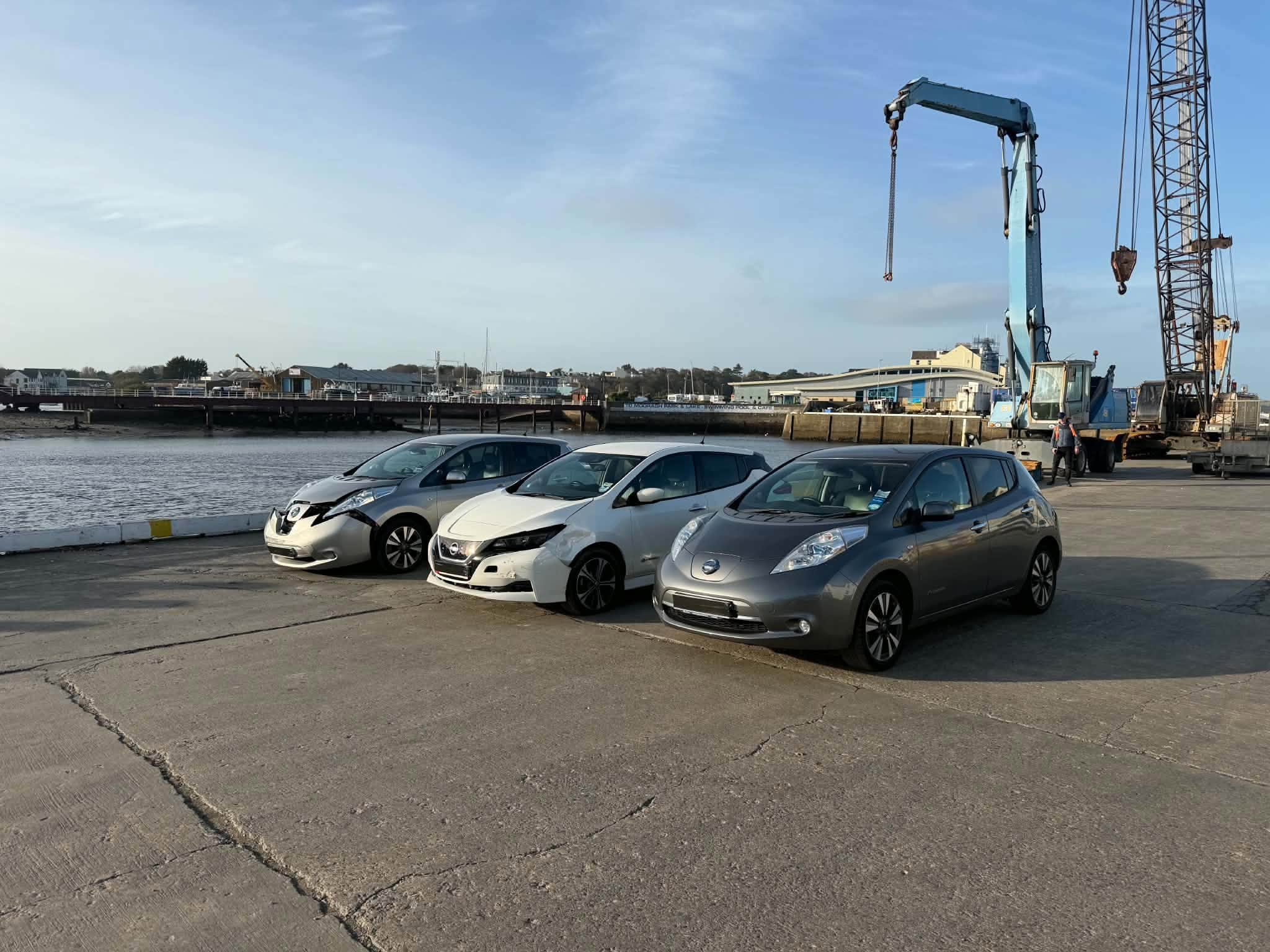
In a blunt social media post this week, Mann Recovery Services revealed it had shipped three written-off Nissan Leafs off the island in just one week, describing the increasing number of damaged and end-of-life EVs as a challenge for owners, insurers and the recovery industry alike.
The company’s criticism centres on a question few prospective EV owners ever consider: what happens when the vehicle is crashed, suffers a major battery fault, or reaches the end of its life?
Thermal Runaway
Unlike conventional petrol or diesel vehicles, damaged electric vehicles often require specialist handling, storage and transportation due to the risks associated with their high-voltage lithium-ion batteries. In some cases, EV batteries can suffer thermal runaway, a chain reaction within damaged battery cells that can lead to intense fires which are notoriously difficult to extinguish.
While the Isle of Man has so far avoided a major incident involving a seriously compromised EV battery, recovery operators warn it may only be a matter of time before the issue arises.
Steam Packet Restrictions
The concern is particularly acute for an island jurisdiction where almost all vehicles, scrap materials and salvage must ultimately travel by sea.
Questions have been raised about what would happen if a severely damaged EV required transportation off the island, particularly given the potential consequences of a battery fire occurring aboard a ferry carrying hundreds of passengers and vehicles. International shipping operators including the Steam Packet and insurers have become increasingly cautious around the carriage of damaged electric vehicles, with strict regulations governing their transport.
The Steam Packet has strict conditions in place regarding the transport of broken down, damaged, salvage and scrap EV’s; conditions Mann Recovery say questions the financial viability.
The firm says the costs associated with dealing with damaged EVs are already becoming difficult to justify.
“Everyday people who purchase such vehicles probably don’t give a thought to what happens with the vehicle when it’s broken down and needs specialist repairs, accident damaged or end of life and needs shipped off island costing hundreds/thousands of pounds,” the company said.
The business also questioned whether sufficient planning has been undertaken for the inevitable moment when a seriously damaged battery pack requires specialist intervention on the island.
Government Climate Policy
The Isle of Man Government has invested significant effort in encouraging a transition towards lower-emission transport, with electric vehicles often presented as a key component of future climate policy.
However, critics argue that the debate has focused heavily on environmental benefits while paying considerably less attention to end-of-life disposal, salvage costs, fire risks, specialist recovery requirements and the practical realities of operating EVs in an island community with limited infrastructure.
For recovery operators at the sharp end of dealing with damaged vehicles, these concerns are no longer theoretical as demonstrated by real problem evidenced here. As more electric vehicles arrive on Manx roads, the industry says the question is no longer whether these issues will emerge, but when.
Mann Recovery Services left its readers in little doubt about its own view, concluding its post with a stark message:
“In short… don’t buy an EV.”