

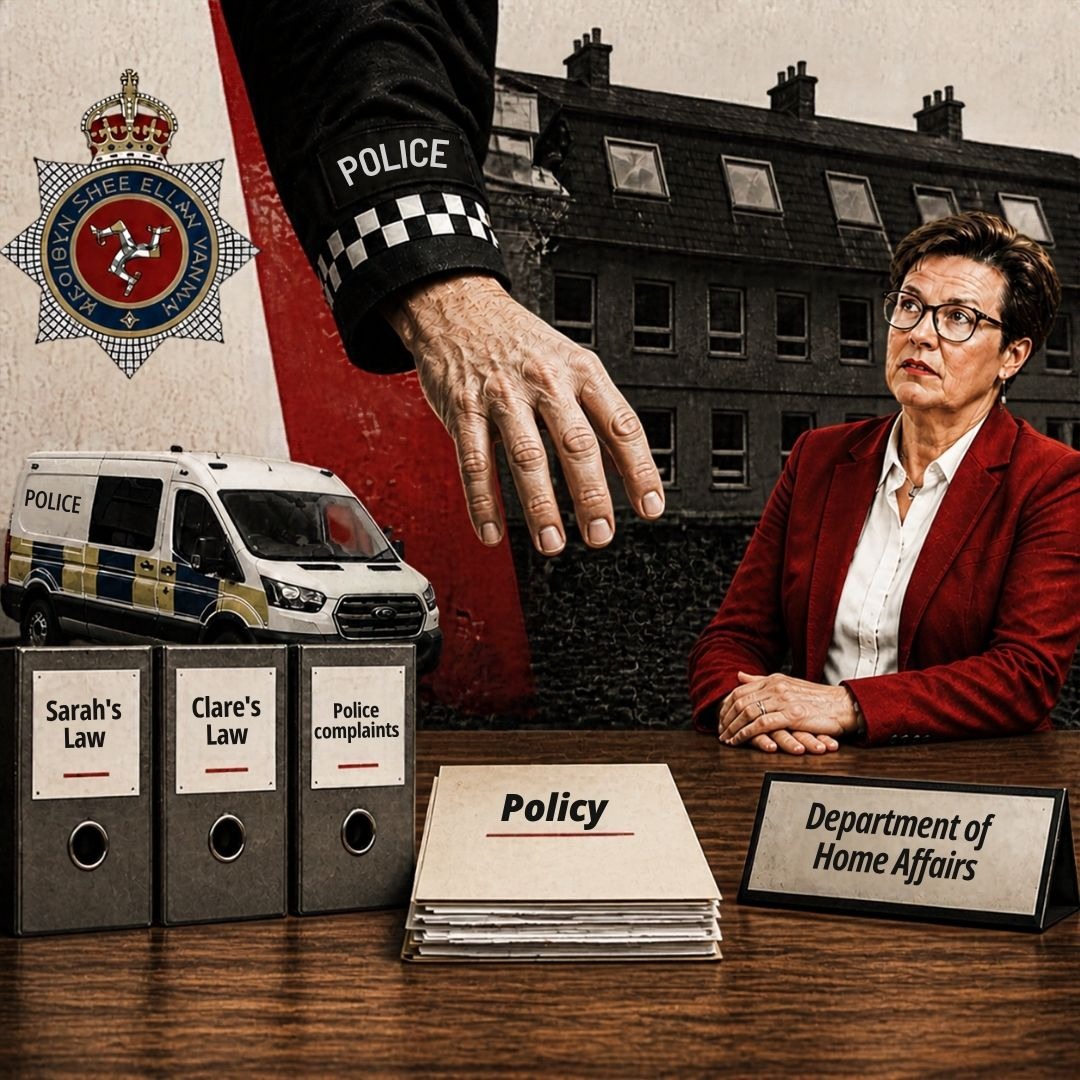
The credibility of the Department of Home Affairs has taken a bashing in the past week.
Scrutiny is increasing, and no one seems won over by the reasons it has given given for its reluctance to listen to public opinion on matters that are incredibly important.
Justice and Home Affairs Minister Jane Poole-Wilson struggled to convince – or even justify – her stance on several issues. Meanwhile, Douglas East MHK Joney Faragher gave a backbench masterclass in persistent questioning.
Some might wonder whether the policy direction is coming from within the department.
There were three issues raised where Faragher put the Department of Home Affairs’ stance into the spotlight.
These were:
The independence (or lack thereof) of the police complaints process.
The absence of an Isle of Man equivalent of Sarah’s Law, a formal scheme to enable concerned members of the public to inquire about the possible risk posed by a known child sex offender.
The absence of an Isle of Man equivalent of Clare’s Law, even though Manx law has it written that there should be a domestic abuse disclosure scheme.
There were several themes that connected the three issues.
There was the minister’s insistence that there were mechanisms in place for all three issues that protected the public interest. (And allied to that a theme that not many people on the outside appear convinced by this.)
We also had the theme of Faragher’s growing frustration at the answers she had been getting, particularly when she felt the department had been answering slightly different questions from the ones being asked.
Who is Setting the Policy?
But the most troubling one was who is dictating policy at – or to – the Department of Home Affairs.
Who has convinced the department, its minister and its members, that it is okay to delay for years the introduction of the Domestic Abuse Disclose Scheme, despite it being set out in law?
Who has convinced the department that the optics of the current police complaints process are fine and that calls for a truly independent system are not just about independence of process, but the public’s perception of independence?
Who has convinced the department – even if it genuinely believes all safety measures are in place to ensure parents are aware if there is a risk of a child sex offender coming into contact with a family member – that it would not be helpful to have a clearly identified equivalent of Sarah’s Law in the island, to ensure the public understood what recourse was available to them?
Is it a coincidence that a connecting factor in all three issues is the Isle of Man Constabulary?
What’s the Problem?
The argument over Clare’s Law is a good example. It was the most tetchy of the exchanges over the three matters.
It seems incredible there is a reluctance, from somewhere, to bring in a scheme that would not only give protection to people at risk of becoming victims of domestic abuse – the largest group of whom would surely be females – but also reassurance.
It seems even more incredible when it is actually written into Manx law that we should have such a scheme.
On the Rack
Poole-Wilson was on the rack in Tynwald. Her explanations of the different avenues for someone to find out if a partner had a history of domestic abuse did not convince Faragher – and probably confused a number of people listening in or watching.
Home Affairs Department members got to their feet in Tynwald, during the question and non-answer sessions, to express their fear that some people might think there were no avenues to seek support and help.
There was even a Facebook post put out after the sitting, with reference to domestic abuse. Presumably it was a recognition that the parliamentary performances from the DHA hadn’t been a success.
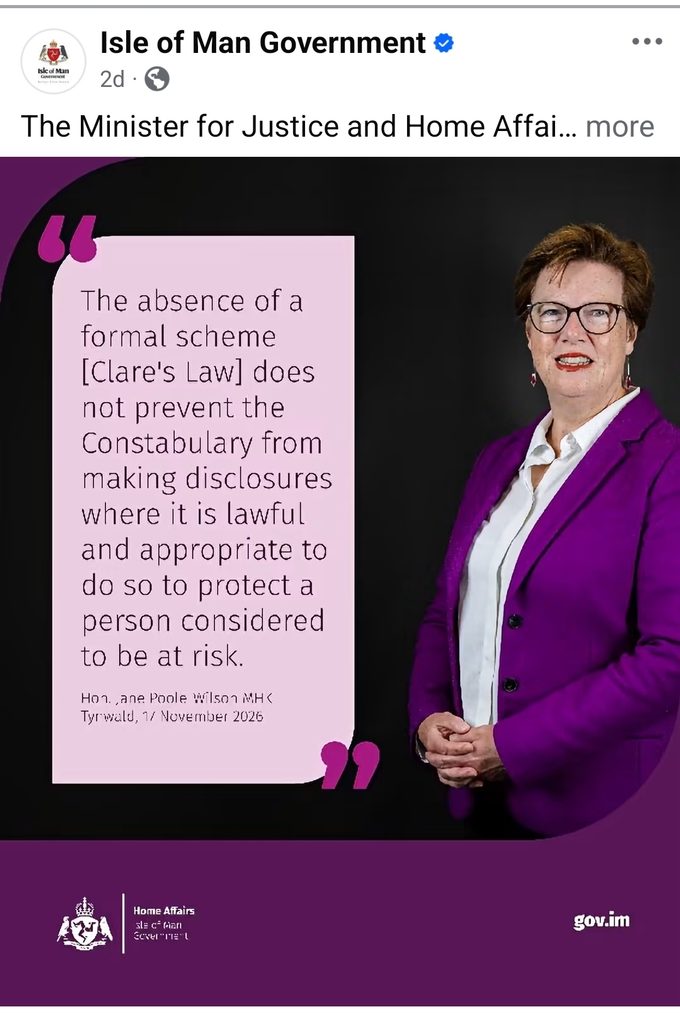
I have no doubt it was not the intention, but it came close to gaslighting people with genuine concerns about what is available now, compared with what could be provided
No one was saying there was no support available.
But people say it’s difficult to know where to turn.
Hard to Find
Many people do not know what the support is and where to go for it.
It’s not very well signposted.
If you know to go to the government website and type in ‘domestic abuse’ it will take you to a section with information. But how many people do know to look on the government website?
The police website does signpost avenues for support, mostly charities. Or it suggests calling 999 or the police headquarters switchboard number.
So, yes, it does say call the police, but it is not exactly shouting about how much support is available through the police force itself.
Given how difficult it may be for anyone to report domestic abuse, more information, clearer information and higher profile information would help.
Along with a clear message that people will be believed.
Defending allegations of inaction on the scheme, Poole-Wilson referred more than once to the Domestic Abuse Multi Agency Forum’s action plan.
You need the navigation skills of Theseus to explore the government website and find a PDF of the policy. When you do, you’ll find it as comprehensible as most government offerings.
A link to the PDF of the latest action plan is at the bottom of this article.
This is Why Clare’s Law Would Help
Do you know one way of ensuring that every single person would know the avenues to find out if they’re at risk of abuse from a partner and how to access, quickly, the support available?
Set up and signpost a specific Domestic Abuse Disclosure Scheme.
One that the law, passed by Tynwald, calls for.
Even better, refer to it in lay terms as Clare’s Law. People would understand that. They’ve heard of it.
You’d think that a government that is always on the lookout for ways to spend more money on marketing might have picked up on that for itself.
Same Old Story
It was the same old story with Sarah’s Law, the colloquial term for the Child Sex Offenders Disclosure Scheme that operates in England and Wales.
The same old story in terms of the number of times the argument has been trotted out against bringing it in here, and the same old story terms of the same argument as that used on the Domestic Abuse Disclosure Scheme.
There are ways in place already to pursue concerns.
But do we all know them?
A formal scheme that is clearly signposted, where everyone understands its purpose, would enhance – not detract from – the work of the other avenues we are told exist.
Bringing it under one umbrella make would it easier for concerned members of the public to understand. And use.
Why are feet are being dragged?
Same Old Complaint
Calls for a truly independent police complaints process have been made for years.
What is the objection?
Justice not only has to be done, it has to be seen to be done. Wouldn’t it be better for that to apply to law enforcement, too?
The argument against that what we have here is just as good for – and better suited to – the Isle of Man. But many are unconvinced.
What are They Afraid Of?
We need to know that the government and the Isle of Man Constabulary are not in a time warp of paternalistic attitudes that the public doesn’t know what’s best for them.
We need to know attitudes have moved forward and that public accountability and listening to public concerns are actually regarded as beneficial for all sides.
A lot of people out there aren’t convinced that is the current position when it comes to the government and constabulary leaders.
What are they afraid of?
There are links below to the Manx.News reports on each of the three issues discussed in Tynwald last week. There is audio of the exchange on Clare’s Law.
Also attached is the latest domestic abuse action plan.