

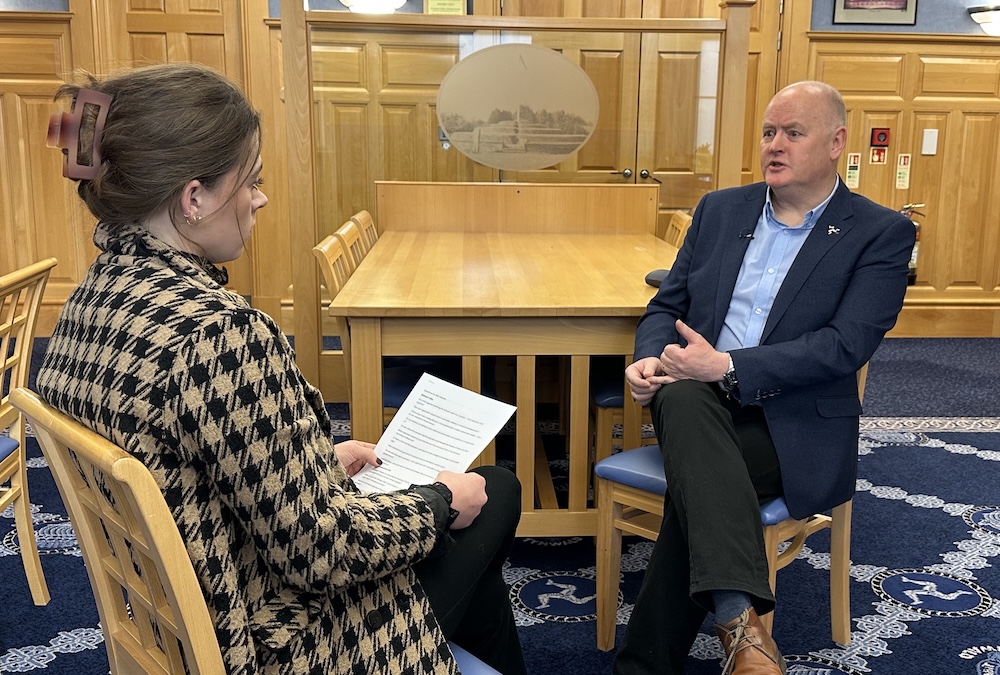
Onchan MHK Rob Callister has defended his use of the phrase “skullduggery” during this week’s House of Keys debate on the Local Authority Amendment Bill, saying the heat of the moment reflected the seriousness of the concerns raised by local authorities across the Island.
Speaking to Manx.News reporter Charlie Morrey, Mr Callister said the handling of Clause 5 — the most contentious element of the bill — had left members feeling that something “more” was driving the amendment than had been publicly acknowledged.
“Serious questions” from local authorities
Callister said his frustration stemmed from the volume of concerns raised by local authorities, many of whom attended the debate in person.
“There were clearly serious questions being raised by all of the local authorities right across the Island,” he said. “When you listened to the comments of the previous DOI Minister, Dr Haywood, and from Mr Hooper, you could clearly see there was something more behind Clause 5.”
He said the turning point came when the current Minister referenced “corruption or the potential of corruption within local authorities” — a claim Callister described as “incredible” and “far too serious” to make without evidence.
Clause 5: shifting services and shifting costs
At the heart of the dispute is Clause 5, which would allow the Department of Infrastructure to transfer services — and their associated costs — to local authorities, to be funded through rates.
Callister said he is not opposed to shared responsibilities in principle, but warned that the clause as drafted lacks safeguards and risks placing sudden financial burdens on local authorities.
“It has to be done in partnership,” he said. “Local authorities need time to implement changes. If central government suddenly decided a local authority must deliver a service with significant costs, they’d have to use reserves until the next year’s rates.”
He expressed confidence that the new DOI Minister, Tim Crookall MHK, would take a more collaborative approach.
A warning from history
Callister drew parallels with his time as an Onchan Commissioner in 2013, when he opposed what he described as an attempt by then‑Minister Phil Gawne to shift substantial Energy‑from‑Waste costs onto local authorities.
“There’s no problem shifting costs over, as long as local authorities have time to absorb them and they are genuine local authority services,” he said. “What we don’t want is national responsibilities being transferred to local authorities.”
Responding to allegations of corruption
Callister was unequivocal in his criticism of Dr Haywood’s suggestion that corruption may exist within local authorities.
“That is a massive allegation to make,” he said. “I’m not aware of any corruption going on. If she has evidence, I would expect her department — as the regulator — to deal with it properly and quickly.”
He predicted that the Isle of Man Municipal Association and individual authorities would respond publicly in the coming days.
What meaningful engagement should look like
Callister said genuine partnership requires consistent, open dialogue between central government and local authorities, many of whom are run by volunteers giving significant time to their communities.
“We should respect that and work with them,” he said. “They deliver core services — waste, housing, infrastructure — and central government must engage with them properly.”
What changes would secure his support?
If the bill returns in revised form, Callister said Clause 5 must be “deeply reviewed” or removed entirely before being reintroduced in a form acceptable to local authorities.
He also suggested the bill could be strengthened by addressing minimum standards for local authority housing and property maintenance, with potential links to future private‑sector reforms.
“We need to lift standards across the board,” he said. “But more importantly, we need a bill that local authorities actually want — because they’re the ones who have to deliver services on the ground.”