
A lengthy and pretty good debate took place in Tynwald last night over a government motion to raise the minimum wage to £13.46 per hour from April 2026.
The proposal, moved by Enterprise Minister Tim Johnston, sought to embed a new methodology linking the wage to 66% of median earnings, which Tynwald had given its backing to back in the summer.
Mr Johnston argued this provides certainty, stating it offers “greater clarity and increased notice for both individuals and businesses than in previous years.”
Treasury Minister Dr Alex Allinson seconded the motion and emphasising the link to economic performance.
“By linking the minimum wage to median earnings, we’re ensuring that the wage growth remains connected to the island’s wider economic performance,” he said.
For anyone else who listened to the whole debate, if you can still hear ‘business’ without just thinking of the classroom scene from Muppets Christmas Carol, you’re better person than I.
Business
However, the motion faced significant opposition from members concerned about the impact on businesses.
Rob Callister expressed his dilemma, noting the decision “will affect 1,000s of constituents, while impacting hundreds of small to medium businesses”.
He highlighted that businesses feel “neither the Department of Enterprise, Treasury, nor the Council of Ministers have taken sufficient time to engage with them”.
However, said he would back it as he had given the pledge to his constituents at the last election.
Jason Moorhouse voiced strong reservations, fearing the increase’s size could have negative consequences.
“Local Businesses are experiencing real challenges at the moment and it’s rare for a week to go by without one business of note closing their doors and blaming costs,” he said.
Methodology
A key point of contention was the chosen methodology. Lawrie Hooper tabled an amendment to revert to a living wage calculation and phase the increase.
He criticised the median wage link as “fundamentally flawed,” arguing, “wages don’t necessarily reflect the cost of living on the island”.
In a powerful defence of the policy, Gary Clueit MLC (possibly the best speech of the entire October sitting) drew on his decades of business experience.
“I have never seen a case of business interests not opposing a statutory wage increase, the arguments and dire warnings rarely ever change, and very rarely do the predictions come true.
“In fact, the opposite is the norm,” he stated. He firmly asserted that “the public, the government, and most especially the workers, do not owe us business owners either a living or profitability”.
The strain on small businesses was a recurring theme. John Wannenburgh declared he could not support the rise, stating, “Today’s motion does not support the pledge I made to champion those businesses in 2021.”
He warned his fellow members that “our actions here today could do real harm.”
In contrast, Tim Glover MHK urged politicians to uphold its July decision, saying: “I think it’s time to back our lowest paid workers on the island and not cow-down to a flip flopping Chamber of Commerce.”
Paul Craine MLC reflected on the wider context of economic disparity, citing a KPMG report, while Kate Lord-Brennan argued the economy could not sustain the jump without a prior rise in personal tax allowances.
“It feels like you know you’re not doing something which sounds desirable, but actually you get to a point where it can do more, more harm than good,” she said.
Rates
Joney Faragher supported Mr Hooper’s amendment, noting the Isle of Man’s current rate lags behind Jersey and Guernsey.
Julie Edge MHK called for an adjournment, criticising the process as “rushed.” She warned: “It is recklessness disguised as we’re being compassionate.”
Chris Thomas highlighted the powerful dissent from the Minimum Wage Committee, which opposed the rise, a point he found “incredibly persuasive”.
In his closing remarks, Mr Johnston defended the policy, stating it gives businesses “a tremendous amount of certainty.”
He pushed back on claims the increase mostly benefits the Treasury, stating the net take-home pay increase for a worker would be about £1,600 a year.
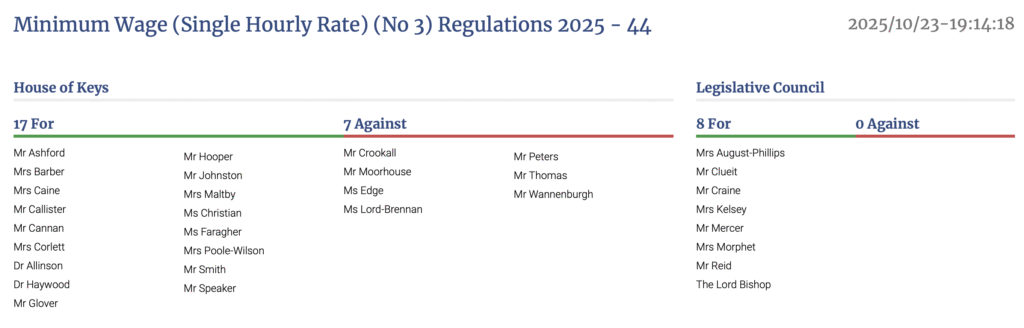
After a debate lasting over two hours the Keys voted 17-7 while MLCs voted 8-0 in favour.