




Tynwald has voted to slash a planned 9.9% minimum wage increase due in April to 5%, following intense pressure from the island’s business community.
The decision, reached after a lengthy debate on Wednesday, marks a significant departure from the previous commitment to rapidly align the minimum wage with a living wage.
The original motion, brought by Julie Edge, proposed a two-stage increase totalling 9.9% this year.
However, Chief Minister Alf Cannan moved a successful amendment to implement a single 5% rise from April, coupled with a promise of “substantial” increases to personal tax allowances in the upcoming Budget.
The debate laid bare deep divisions over economic strategy, pitting concerns for business survival against ambitions for fair pay.
Business Pressure
Julie Edge opened the debate by arguing the planned hike was now unaffordable. She warned of job losses, reduced hours, and price rises that would “swallow up any pay uplift”.
“Caring about low paid workers, includes caring about whether they still have a job and work and pay for that job,” she said.
Her motion sought to “avoid unaffordable hikes” and “buy time” to assess impacts, aligning the April increase with a 5% recommendation from the independent Minimum Wage Committee.
Amendment
Alf Cannan framed his amendment as a necessary intervention to prevent economic damage.
He cited warnings from business groups of a “real contraction in employment” and argued the government must now “share the burden” with employers by using the tax system.
“Business is asking for Tynwald to share the burden, and rightly so,” he said. “The messages that I’ve heard throughout all this is that business recognised the sentiment of what Tynwald is trying to do.”
He dismissed calls for a one-month adjournment as a “smoke screen that has been thrown up today by the Speaker and by the left,” urging members: “Today is a day to stand up and be counted.”
Betrayal
Opponents of the change argued it betrayed low-paid workers and undermined policy consistency.
Rob Mercer MLC delivered a powerful critique, saying that “a minimum wage that does not meet minimum living costs is not a safety net”.
He warned the move “risks pulling the lever on a trap door that drops people into permanent dependency on state support”.
He challenged the narrative of widespread job losses, noting the island’s tight labour market with 1.6% unemployment and hundreds of vacancies and criticised the shift to personal tax allowances as poorly targeted.
“A tax cut that you do not qualify for does not help you to pay the rent or put food on your family’s table,” he argued.
“Raising personal allowances is not targeted support for the low paid. It is a broad fiscal measure that benefits middle and higher earners most.”
Ballsing
Lawrie Hooper was scathing in his assessment, accusing the government of “completely, utterly, royally ballsing this up.”
He highlighted Treasury data showing that 4,000 of the island’s lowest earners would see no benefit from a personal allowance increase.
“What’s being proposed here is saying MHKs and people that earn what we earn will get a tax break, but people earning £12,000 a year will not,” he said. “That is sickening.”
Dr Alex Allinson, who was dismissed as Treasury minister this week, warned the amendment “completely reverses” previous policy and “leaves us with nothing”.
Show us Your Package
A central tension was the lack of detail on the promised tax changes. Speaker Juan Watterson proposed a one-month adjournment to see the full fiscal package in the Budget.
“We’re voting on a knee jerk amendment to circumstances of government’s own making that is no more evidence based than the evidence that they are saying that we all need,” he argued.
This was supported by members including Sarah Maltby, who said, “I will not be in that camp of people who were happy with the smoke screens of the former Treasury minister, who just… did go forward with things without having proper feasibility studies.”
However, the adjournment motion failed by 16 votes to 8 in the Keys and 4 to 3 in the Legislative Council.
Unity
Enterprise Minister Tim Johnston indicated his department would work “constructively” to reflect Tynwald’s shifted will, while new Treasury Minister Chris Thomas sought to reassure members the Budget would be “fully costed”.
After the adjournment failed, the debate continued.
Kate Lord-Brennan read a letter from the Minimum Wage Committee, which had met urgently on Monday night and backed the 5% rate.
The committee welcomed the “reset of the policy” and a return to an “evidence based framework”.
In her closing speech, Julie Edge appealed for a decision to protect the economy. “Businesses cannot continue to keep taking the brunt of every decision we make in here,” she said.
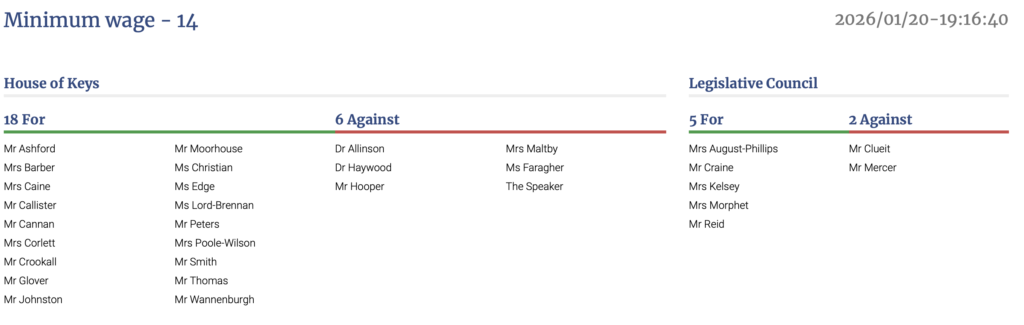
Alf Cannan’s amendment was carried by 18 votes to 6 in the Keys and 4 to 3 in the Legislative Council. The amended motion was then approved by 18 votes to 4 in the Keys and 5 to 2 in the Council.
The decision means the minimum wage will rise to £12.86 per hour in April, a 5% increase from the current £12.25.
The government’s pledge to compensate lower earners through the tax system will now however face intense scrutiny when the Budget is unveiled next month.